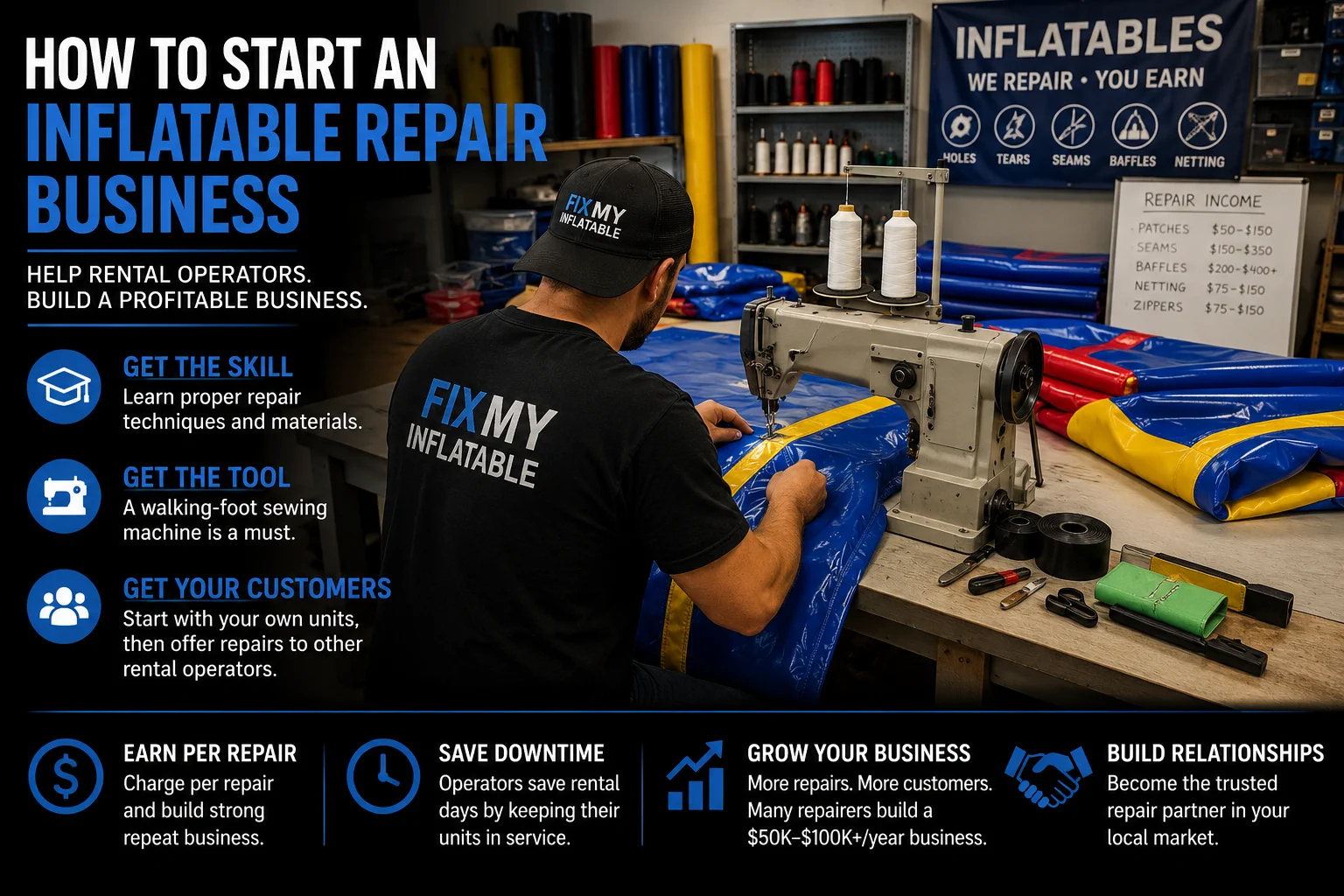
Every rental operator eventually faces holes, seams, baffles, netting, and blower issues — and most have no local repair option, so they ship units out and lose rental days. That gap is the opportunity: a nearby, fast repair technician is worth a lot to operators who are losing bookings to downtime.
- The skill — training so you can handle every common repair confidently (patching, seams, baffles, netting, blowers).
- The machine — a portable walking-foot sewing machine plus basic supplies (adhesive, thread, needles, patches).
- A workspace — even a garage with a repair table works to start.
- First customers — your own units first, then other operators in your area.
Two ways: charging per repair (holes, seams, baffles, netting — each a line item), and saving operators downtime (a fast local turnaround is worth a premium over shipping a unit across the country). As you build a reputation, repeat rental-operator clients become steady recurring work — a repair division you can grow.
Inflatable repair revenue is usually built one repair at a time. The live FixMyInflatable calculator currently uses $275 per repair as an average example. Using that same example, the volume math looks like this:
If you already own rental inflatables, there is a second financial benefit: the repairs you perform on your own inventory can reduce outside repair and shipping costs while keeping units closer to rental-ready.
| Repairs per week | Example weekly repair revenue | Example annual gross revenue |
|---|
| 2 | $550 | $28,600 |
| 5 | $1,375 | $71,500 |
| 8 | $2,200 | $114,400 |
These are gross revenue examples before materials, travel, taxes, insurance, marketing, and other business expenses. Real repair prices and repair volume vary. The point of the table is to show how a small number of weekly repair jobs can compound when the work is consistent.
Start with proof, not a huge marketing system.
Step 1
Repair your own units first.
Build skill on the same problems rental operators already face.
Step 2
Document the work.
Take clear before, repair-process, and finished photos.
Step 3
Make a list of nearby rental operators.
Explain the types of inflatable repairs you handle instead of sending a generic "we fix stuff" message.
Step 4
Use a simple intake process.
Ask for the unit type, damage location, photos or video, and when the operator needs the unit back.
Step 5
Quote the actual repair.
Separate patches, seams, baffles, netting, slide-blanket work, blower issues, and other repair categories.
Step 6
Ask repeat customers for reviews and referrals.
Rental operators know other rental operators.
- Customer / company name
- Phone and email
- Unit type
- Manufacturer if known
- Damage location
- Description of the symptom
- Photos or video available
- Requested turnaround
- Inspection notes
- Approved repair scope
- Repair completed
- Test completed
- Returned to customer
A repair business becomes harder to manage when every unit arrives with a text message and no job record. A simple intake process protects the customer, the repair technician, and the repair schedule.
Business registration, taxes, insurance, and local requirements vary by state and city. Treat those as real setup tasks, but do not copy another repair technician's legal setup and assume it applies to you. Check the requirements where you operate and use qualified local professionals when you need tax, legal, or insurance advice.
You do not need a full repair company on day one. A realistic path is:
Own units → a few outside repairs → repeat rental-operator customers → scheduled repair workflow → dedicated repair revenue
The point where you expand should be based on repeat demand and your ability to deliver consistent repairs, not on a revenue claim alone.
- Save on your own repairs
- Eliminate shipping and downtime
- Add a new income stream
- Fast turnaround keeps units earning
- Control your own quality
- Serve other operators nearby
- Future-proof your rental business
- Low startup cost relative to the return
Learn the skill → get set up with a machine → repair your own units first → take on a few local operators → grow into a repair division. Many start it as a side income alongside a rental business and scale from there.